
The ability to dart across short expanses of available space and the incredible dexterity required to weave through narrow cracks and crevices without getting trapped or trampled on are attributes of highly evolved species of creatures of the animal kingdom. Such qualities are highly prized in order to survive or gather food in very challenging habitats where only the fittest survive.
I discovered that the speed of rodents, the agility of cockroaches, the lithe grace of snakes in their natural habitats can also be spotted where I live. That highly adaptable, quick and dexterous breed of the fittest form of life is abundant in my city.
With highly developed reflexes to stimuli and a competitive spirit only to be matched by the most efficient of predators in existence, these creatures can’t be stopped from reaching their goals. As you get close to large metropolitan areas, you may view this creature in overwhelming numbers. This creature is gifted with more speed, greater agility and higher dexterity than the best of them if only lacking sometimes in as much abundance of grace.
I am talking of none other than the urban commuter navigating their way to work through subterranean train systems during rush hour into New York City.

The other day, as I participated in what is a daily ritual for most, I found that it’s possible to gather large life lessons from a few minutes of travel in the PATH train system crossing below the Hudson river to reach the World Trade Center on the other side from Jersey City.
As I neared the station, I could tell that the randomness of the throngs of people on a regular summer morning seemed to take deliberate direction. Scattered people started to merge into streams, streams of people started thickening, the thickened streams started to flow converging towards about four points of the train station. The glass front of the station was visible beyond the stream of bodies through interstitial spaces constantly shifting.
I knew that the revolving glass doors were those four points, testing the skills of the regular commuter vs. the uninitiated in getting through fast. I’d have to enter those doors, go with the flow, relieved of the burden of my own volition and individuality for a few seconds, gently pushed in, not necessarily literally but by the great will of the people behind me.
I don’t know exactly when it happens for others but it happens right about then for me. I change to a commuter as I enter.
I change from a regular person to a subterranean, goal-oriented creature of the underground tunnels. That moment when I am in a quadrant of the revolving doors, alone for a few seconds, dissociated from the crowds is when I change.
As I enter I map the terrain of this particular station in Jersey City in my head. Two sets of metro pass vending machines on either side, two huge sets of turnstiles next to them and the great long escalators in the middle featuring a 150-foot sheer drop into the netherworld of tunnels of trains below.
Today, going along with this flow of life around me, I enter. I rush to the turnstiles, privately thankful some money is left on my metro pass. I am able to get to the turnstiles before those others at the ticket machines. Good for me. Mentally I scoff at those novices who loiter around trying to figure out which way to go and how to push in the metro cards into the slots. Clearly not natives of the city, these people, I say to myself, forgetting that it isn’t that long I’ve been here myself.
Time, time is of the essence. I have to reach the bottom of those escalators fast.

I notice that most people are rushing in the same direction as me dressed in black with lunch boxes slung over their shoulders with a sort of glassy look on their faces, eyes fixed at some point in the distance. They are focused on reaching the bottom like automatons drawn by an invisible force netherwards.
I pass by a clueless lady who is clearly different, not a commuter, rather slow at the entrance to the escalator. On my way, I dodge a wayward umbrella and an overstuffed bag and slide between two people to reach the top from where the descent starts.
Why don’t people keep their elbows to themselves?
Everyone looks down to catch that first step, balance for a second, then rush to the left of the escalator so they can keep rushing down the steps one at a time while in motion already. The escalator goes fast but people on the left go faster. Occasionally, an odd person who does not know this convention is told to move to the right where people can stand still while moving down.
I am undecided as usual. I stand on the left first. People keep moving here in front and behind, in a straight line. It’s dizzying, looking down at the stretch of heads moving fast for 150 feet, feeling a mental and physical pressure to move and keep moving. The metal steps near my feet are also an amalgamation of straight metal lines of shiny surfaces and dark ruts, in constant motion.
I can’t keep pace with this, I think. I find a space between two stationary people to the right and I slide in the space between.

I am about half way down the great escalators when I hear a rumbling sound below. The great sea of people on the down escalators about to start their journey fidget in response. Although there is no remarkable change of pace because people are already going as fast as they can, there is a palpable change of energy on our escalator.
The train is coming. It is here. People have to reach it. There is a pressure to move faster on everyone, a palpable force going through our downward descent.
I should not have abandoned the left side, I think now. I shouldn’t be on the slow right.
So I carefully step to the left again with considerable more difficulty than I had stepped to the right. People are going fast here now. I go down faster and faster too, skipping down the steps. Fortunately, I see a whole long empty space in front of me because people in front have been running down now to catch the train. There are three women behind me close at my heels.
Sudden obstruction.
As I rush down I see a man stop in front of me to speak to another man on the right side. Both stop moving. It looks like they’ve met after a long time.

I reach the man obstructing my descent but they don’t move. The sound of the rumble becomes louder and louder and louder. There is a screech which means the train has stopped. A thick stream of people are flowing into the escalator on the opposite side moving up. It means only a few seconds before the train leaves. I must do something.
Yet, I feel hesitant to say either “Excuse me” or “Can I pass?” My regular personality is interfering with this commuter personality of mine. Should I be rude and ask him to move immediately? Why can’t I wait a few seconds?
I stay silent. The women behind me shift and get impatient. They human-tailgate me. So I move to the right.
Now the woman in front moves forward and says “Excuse me” rather loudly, as I should have. Translation: “You’re not supposed to stand here during rush hour!”
The man quickly moves to the right. The three women and a hoard of men and women behind them rush down in a straight line. I can see them getting off the escalator at the bottom and running helter-skelter to pass each other and disappear to the left where the silence tells me the train is still waiting.
Feeling very bad internally for having been too weak to say “Excuse me,” I finally manage to follow the rush downward. I reach the bottom and see the three women who were behind me rush in through the nearest door of the nearest compartment of the train. It’s too late to pick and choose doors. Some of the crowd following them also manage to get in.
There is a young girl a little behind the rest. Time is up. The door closes on her and then re-opens since she has managed to squeeze in.
I need a few seconds more.
I make a last desperate effort to reach the doors.
Alas! The doors close just inches from my face.
I see the three young women and the young girl and the backs of the two people on either side of the glass doors (who have been standing with complete nonchalance to the commotion all around protecting their space all this while) move slowly away as the train pulls away from the station.

I am the only one in my immediate crowd left behind on the platform.
Dejected, I see myself as an utter failure. I debate whether one of the empty metal benches on the platform is my rightful place now until the next train comes.
Just as I am about to sit, I hear a faint unexpected rumble.
I am sure it’s not for me. Louder and louder the noise grows. The wind blows hard along the tunnel against my face and a train comes into view in the dark.
I can’t believe it! The letters WTC glows on the front. It’s mine alright.
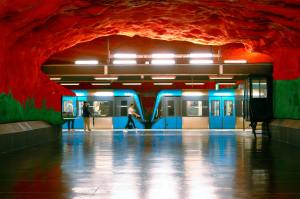
A whole, nice, empty, glowing train with empty seats during rush hour on an almost empty platform.
Quite irrationally, I feel victorious. I step in.
I get out at the World Trade Center station and merge with the crowds rushing forward towards another set of very high escalators. As the sea of humanity lifts me up towards the surface of the earth, I give up my individuality once again and surrender to the multitudes ready to spend yet one more day being useful.
I wonder how many steps ahead I would have been had I caught that previous train.









 bottledworder
Comments welcome