
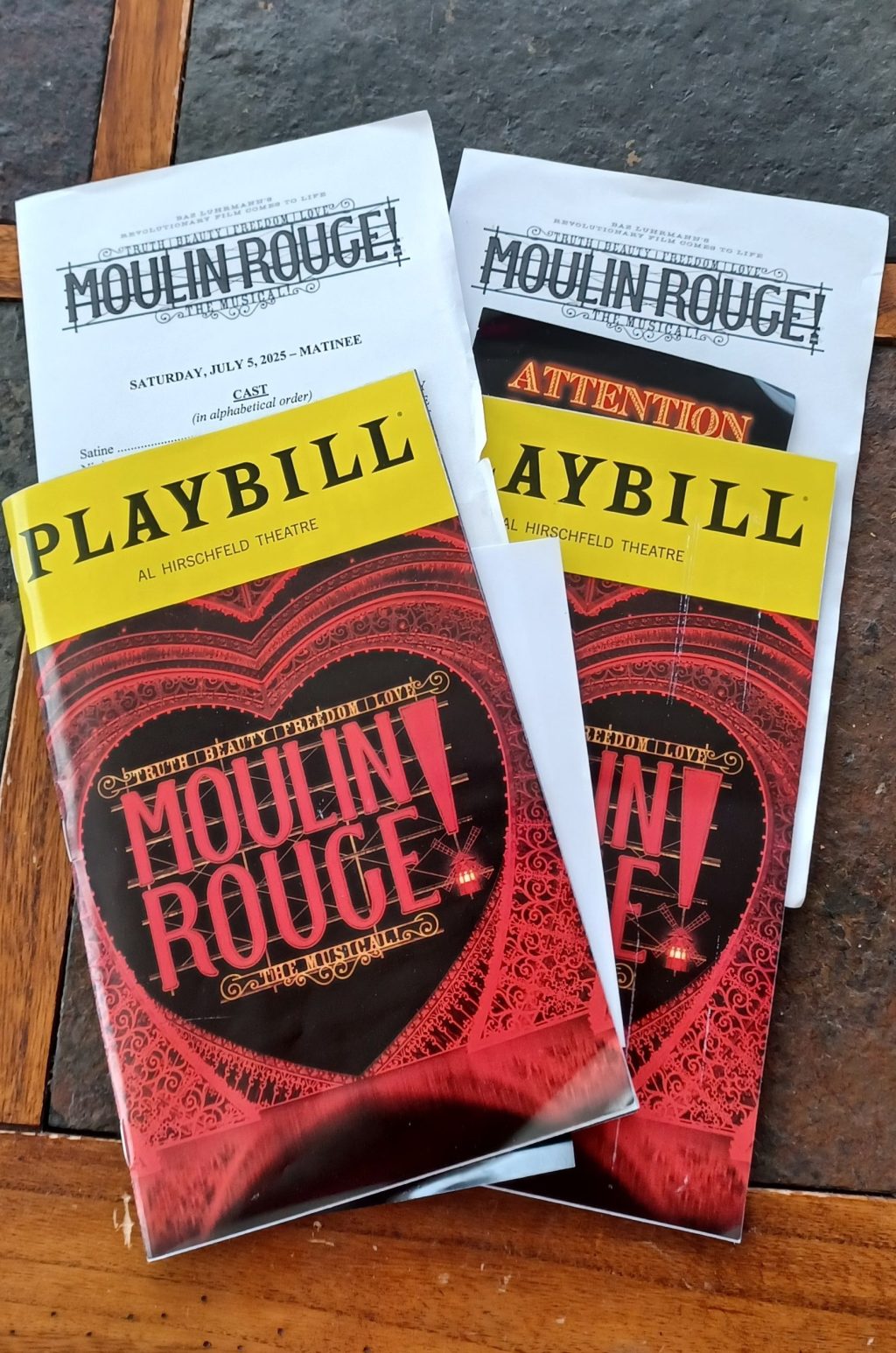

So it’s July 5th and we go to see this show on Broadway. It’s the matinee and something unusual happens about half-way through, a little before intermission. But I can’t tell you what it was without letting on a little bit of the plot so spoiler alert.
It’s a show. So, as always, there are people in love. That’s not giving away much. But as the heroine is dancing, she falters a little and another dancer comes to help. Then she coughs in the next scene.
In a story you know that no one coughs. If they cough, it’s going to turn up again in the plot. You can be sure of that. A cough means something.
The woman is a performer (of sorts) in the story so she has a dressing room. In the dressing room she drinks from what looks like a cough syrup bottle from time to time as she talks. It’s a scene with a bit of heightened emotion. In real life, you might be putting an eye drop into your eye in front of the mirror or drinking from a syrup bottle next to the dressing table or doing any number of things in your own dressing room as you are being emotional and torn up and such like but on stage? Would you ever be drinking from a medicine bottle if it didn’t mean anything?
The heroine indeed was getting sicker and sicker in the story. Or was she? Or was it that the actress performing the lead role was getting sick as she faltered with some of the higher pitches in the songs?
I’m Indian. So I think that see, this is Broadway, not Bollywood. They all actually sing the songs as they act here. It’s not background music and lip syncing. Is that why? Is she sick? Which she? The female lead or the actress? Or both?
Or were we imagining things? Was the singing not faltering?
Then suddenly, about half way through the show but somewhat before intermission, the female lead drinks from the syrup bottle and leaves the stage. Then there’s this booming voice from backstage that tells us that there will be a 10-15 minutes’ gap and we can go roaming about the theater if we want.
That’s strange, I think. So does this girl about two rows behind me.
That girl is one of those. It’s the person they should mark on the seating chart when they sell the tickets. Orchestra, Row X, Seat X. She is that person who has seen the show many times over and needs to talk about it. Of course she thinks it appropriate at every turn of the plot to speak her mind, to comment, to analyze and tell her companions about the inner workings of productions and sets. Of course those of us in front of her, facing the stage, can’t see her. Her companions are completely silent. They are her captive audience. What can they do? I have found out bits and pieces about many things already–the actresses, about other places the show has been to, about even the elephant, this huge blue prop on one side of the stage. Apparently, in town X, where she’s also seen the show, it was a frame, not a prop.
These days, considering all of the political and social and economic stuff going on everywhere, whenever anything goes out of script in Manhattan, I worry. Whether it’s a train stopped too long in a tunnel or an empty subway train when it should be full or just extra police dogs at the station, it makes me think. And pause. And worry. Considering so many of us are in the theater together in a small space on an important weekend and it’s close to the city’s hub, Times Square, and that we are just stopped, out of script quite literally, at a theater, I pause to think.
A stage assistant comes in through downstage right and takes the syrup bottle down from the dressing table and replaces it with a new one as efficiently as someone refilling a first-aid kit. . The couple sitting next to me go off. The girl behind me declares that she has gone around and spoken with a sound artist who says that one of the actors is sick.
Really? Hard to tell since the character in the plot is also sick! How sick we don’t know yet, either actress or character.
I decide to go downstairs to the ladies’ room. Being that it is the holiday weekend, there is a long line from the basement through the steps to the first floor. And every woman in that long line is speculating and has a different explanation for the pause.
As I reach the end of the line, which is in the basement, announcements can’t be heard anymore. But there are ushers here who suddenly start warning us: “Three minutes left,””two-and-a-half minutes left,” “two minutes left” and so on. Many leave. I rush back to my seat too.
The show starts again. The scene returns to the dressing room which, in the story, is the inside of the blue elephant. The woman, in the same dress, is next to the same dressing table. But she is quite another woman. The booming voice announces that the role of Satine is now being played by…and it’s another name.
The Duke comes in through the door. He says, “You’ve changed.” Or maybe “You’ve changed?” Or maybe he says “You’ve changed!” It’s all in the tone.
Duh! This is the dressing room! That’s clever.
The audience laughs. The girl behind us makes a loud, gleeful sound. I guess that this actress is more famous than the last one. Was she called in to come earlier than when her evening show starts? Or is this someone entirely different, neither meant for matinee nor evening?
The show goes on. The couple next to me doesn’t come back. The booming voice does not return either with any comment or explanation. Strangely, the girl behind me, whom I’ve started thinking of as part of the whole experience that came free with the ticket, is silent.
Is she uncomfortable? I know I am.
Who is this Satine? Where is the old Satine? Is this the same Satine or is she not? She dresses and moves and talks like the old one. She interacts the same with the others on stage as if she is Satine. Yet she is not the Satine that we had grown to know. Should we believe her? Should we trust her? Had she now been a completely different character with a different name who came in at this juncture trust would be no big deal on our part. But it’s hard to trust someone too similar to someone else yet not that someone else we knew. Our brains say all’s okay but our hearts tell us that it’s pretense.
But of course it’s all pretense! Can you accuse someone of pretending or faking it on a stage where everything is already all pretend, all fake, entirely make-believe?

In the theater the plot is what guides our temporary flight of fancy. Yet we start caring about the characters. Not as characters in a story but as people though they are make-believe people in a make-believe plot. We too inhabit the story briefly as we get to know them. That’s the whole point of theater.
Yet, these figments of imagination are guided more by the coordinates of the plot and characterization i.e. the screenplay rather than by our relationship to the people on stage. That’s when they ought to be considered as not people at all.
I knew this in theory of course. So did the girl behind me. Yet she was silent for the rest of the show. For me, it was so hard to accept quite another woman as the same woman we knew as Sateen in the first half of the show. She was dressed the same and spoke as the same person and yet, for a time, I felt this sense of betrayal. How could her man love and adore another woman so? How could life go on as if nothing had changed for everyone else too?
Unless I could think of the goings-on on stage as real, I’d lose the whole purpose of enjoying the show. If the stage was real, I was going to judge the woman now as fake and blame all the others for being unfaithful in their loyalty to her since she had changed. To stop the blaming, I’d have to remember that Satine wasn’t real at all and that this actress could honestly pretend to be her as much as the other woman a few minutes before. Christian, the male lead, could as much be in love with this woman as the other woman without any accompanying guilt because it was all the same. We could cheer them on too without any guilt.
But there was discomfort. How could we resolve the make-believe and the real yet enjoy the paradox of theater at the same time that this replacement exposed?
And so the story went on with the same plot with a changed woman and a changed audience quite disconcerted by all the paradoxes of the afternoon.












 bottledworder
Leave a reply to adamjasonp Cancel reply