

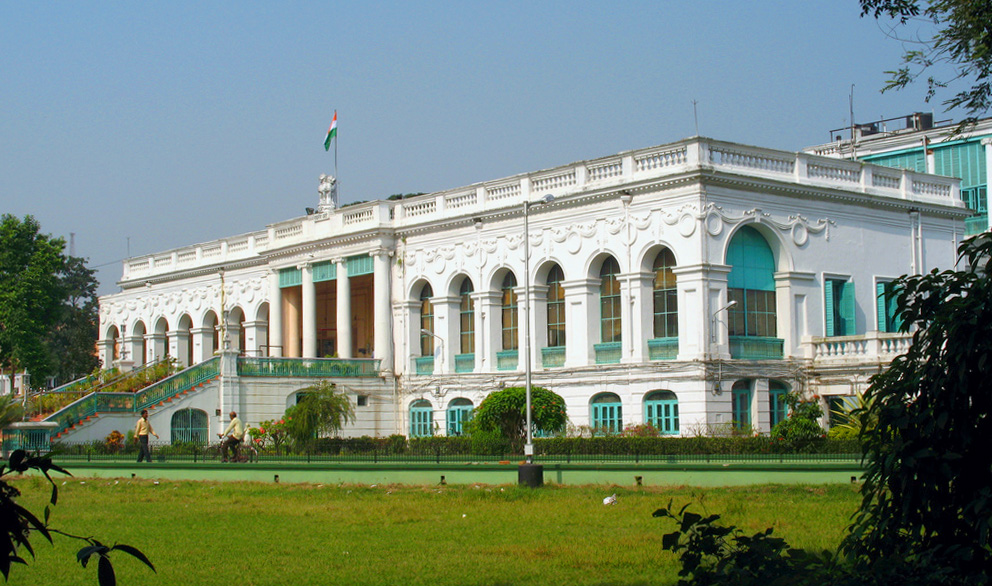
Imagine rows and rows of long tables made of dark, burnished wood in a dark, very large, majestic hall. Imagine rows of table lamps throwing circles of quiet, golden glows on each burnished top stretching to infinity. Visualize rows of heads bent over books in a very, very, quiet space where no one is speaking but in whispers. The walls on either side are lined with shelves of books and high, arched, windows that look out onto green lawns. It is cool inside. A space where the darkness dazzles as you walk in from the burning sun outside after having walked down a long path lined with trees and green grass and a huge, imposing flight of steps made of white concrete leading up to the building.
When I think of a quiet space of contemplation, I remember the National Library’s reading room in Kolkata, India in the late 1990s. There are no computers. I copy everything by hand on long, foolscap exercise books. I cannot remember Xeroxing anything then inside the library although photo copying stores were ubiquitous in the city at that time.
It takes a long, bumpy ride on Bus 230 to reach here. But one has to pass the tremendous crowds and cross the long lines in front of the bus stop at Alipore Zoo first. There are no computers so the low light of the reading room and the focused golden glow of the lamps is unbroken by bluish screens.
When I visited this space regularly in the late 90s, I didn’t know much of the haunted history of the Belvedere building “with 45 kilometers of shelf space.” Yet I felt the spirit of the library there in the reading room. Warren Hastings, the Governor General of the East India Company lived here until the 1780s. The reading room was the “palace” ballroom. Hastings’ ghost was reputed to haunt the corridors of this building looking for a black bureau supposedly containing papers that would prove his innocence during his impeachment trials in the Parliament of Great Britain later that century. A secret chamber was discovered in 2010 that gave rise to a lot of speculation about the room as a British secret punishment space or treasure trove.
The reading room was a quiet, happy place to spend time with books. A great space to reflect, to think and to be in the presence of people who know not to talk loudly, to whisper, to not damage books (generally speaking, not always) and to value what lies between the covers. There was a huge card-based catalog outside as you entered the library. You couldn’t just click a link to read books then. Books had to be ordered by submitting paper slips. Spending time here to read was not about learning how to do something or how to make something or solve a problem immediately. It was about ideas that needed to be contemplated for a long time not necessarily translating to something that could be implemented tomorrow.
My bus ride would consist mostly of loudness those days. The conductor would go “ticket, ticket, ticket” and when people did not seem to hear him, he would approach your face with a bunch of tickets in hand, made of stiff paper, and flip, flip, flip, thumb on the edge of the pile of tickets, deftly held between his fingers according to price, as only Kolkata bus conductors can do., That distinctive sound of shuffling tickets was something not absolutely necessary, yet supremely effective with passengers contemplating quickly disembarking on the sly.
Then, as we came to a stop with a bump, he would sidle through the packed bus very fast, screaming “aaaste ladies,” prolonging that first vowel sound [Translation: Go slow. “A ladies,” always in the plural, is getting off!–This was a warning to the driver so he did not zoom off immediately.] There were other sounds too. The cackle of schoolgirls, men talking and bus horns blaring as our bus would overtake another on the road with the screeching sound of tires.
No cellphone talk exposed us to one-sided conversations in those days though. We did not encounter the loud silence of texting by fellow passengers either.
When we would reach Alipore Zoo, it would be a slightly different crowd. Most would be huge groups of several adults with multiple children, people from the outskirts of Calcutta unused to the city. Many would cluelessly roam outside the imposing gates of the Zoo, not quite sure of where they were. They would have just arrived by long distance bus or train rides to visit the city as people within the city progressively lost interest in the Zoo.

Oceans and decades away, my experience with the New York Public Library’s Rose Reading Room has been similar. As the NYPL website states, the majestic room, “78 feet by 297 feet—roughly the length of two city blocks—with 52-foot-tall ceilings displaying murals of vibrant skies and billowing clouds” hits you with similar imposing feelings in essence. The room isn’t as dark but the rows of burnished tables give the same feel of openness in a closed space and a similar feel of difference and contrast with what lies outside.
Right outside, the crowds around Bryant Park full of tourists, office goers, food carts, kids throng the streets and sidewalks and the green lawns. Even inside the NYPL, groups of tourists hang around the corridors and restrooms, some of them parts of tours that show the building. Yet, even though membership has no cost, the people inside the actual main reading room are very similar to those I remember in the National Library’s Reading Room in Kolkata. People never dress ostentatiously, some even come in crumpled clothes, are quiet, polite, and unassuming. Yet they exude something that people outside, on the street, cannot aspire to become or achieve in a short amount of time.
What is it?
The idea of “luxury” is culture specific to an extent. The feel of luxury, however, is not, especially when it inheres in places and people who achieve exclusivity by liking or sharing values that put them in places together when the person on the street is quite unable to grasp or measure objectively what it is that draws them there. This New Yorker article mentions The Rose Reading Room and the Real Meaning of “Luxury” in New York City at NYPL directly, mostly focusing on the architecture and décor of the place. But the luxury of a reading room does not quite reside in its walls and curtains and woodwork. It is a combination of the place and the people. Perhaps the luxurious feel of the National Library in Kolkata was more muted in keeping with the taste of its patrons but this feel of something identifiable, emergent from the people and the place was very much present nonetheless. (No longer muted, alas! The white imposing steps have been painted in garish colors now.)
When people say reading improves everyone, that reading is for everyone, no one is happier than me. Yet, my nostalgia for reading rooms like these is always laced with doubt about the source of what it is that appeals. I cannot define it clearly but I always wonder whether the love of reading books is always laced with histories, peoples, shared values, leisure that everyone may not have a claim to or may need to sacrifice too much of their lives to reach. That worries me.
It’s not quite as simple as getting on a bus or a subway train to reach your reading spot. And yes, the essence of that applies to clicking on links as you sit on your couch too .
Reading rooms with painted ceilings and brocade drapes are no longer necessary. In fact, they are quickly becoming relics of the past. We may say that full democratization of knowledge is here when we can click on a link to read no matter where we are. For argument’s sake, even if we were to compensate for digital divides, even if everyone was to have equal access to devices and items behind paywalls, would everyone feel equally comfortable in those spaces behind those links even if they could read with equal ease? Would everyone have equal access to that easy familiarity of living in the luxury of existence whether it is through delving into a book on parchment, paper or pdf?
After I finished writing this post, I tried looking for copyright-free images of the reading room from the 1990s at the National Library in Kolkata that I talk about. I couldn’t find a suitable picture but I found an interesting list of Kolkata’s reading rooms here: In pictures: Four heritage libraries and reading rooms in Kolkata I tried to write the post avoiding words like “insular,” “privilege,” “class” etc. as a self-administered exercise. I also told myself that I could start sentences with “but.” Why not?









 bottledworder
Comments welcome