


It was all there. The little bits and pieces of India that had managed to pass through strict inspection. For some of us, it was in the form of three or four bottles of the leading brand of coconut oil, enough to last two years of our serious, nothing but scholarly existence in this well-populated university town in Florida. Enough to oil our heads and necks and the pages of our complicated advanced level cheaper Indian reprints of textbooks that had traveled with us through endless labyrinthine chutes of airport security.
For some of us, it was arrays of bottles of mouth watering achars carefully packed by our mothers and grandmothers– green, red, brown, yellow, reddish brown, yellowish red. Mango, Gongura, cauliflower, fish, meat– you name it. For some of us, it was a Hawkins pressure cooker or a plastic comb or a unique handled saucepan that mom would make tea in everyday at home. It was a piece of our everyday packed into our suitcases and our memory of our evenings when mom would sit with us and we would tell her everything about what happened through the day in every detail.
Huge suitcases with our details on the cover. Perhaps it was our brother or father or mother who had printed our names in those huge letters (many of us were smarter even then, we took computer printouts and stuck them). That suitcase would never again seem like a piece of impersonal green luggage bought at Sarkar and Sons in a hurry in between visiting our eldest Mashi and our second-most-important married cousin’s in-laws before leaving Calcutta. It would remain pushed into the closet or dumped with three other suitcases of our roommates in the corner of the living room.
The room, by the way, would be the scene of endless graduate student parties and potlucks, unimpeded as it was with little furniture. (Whatever furniture was there had been handed down by seniors leaving town or better, rescued from the dumpster–usually the repository of orphaned furniture left behind by students.) The suitcase, sitting in the corner of the living room, would be a perpetual reminder of that look in our mom’s eyes as she finally let go. With the oil and the achar and the comb and the salt shaker and the pillow cover (that we never told her later was too small for the pillows here) she had finally let go of us and resigned herself to the distance and the lonely life in India.

Some of us never brought the oil or the steel saucepan. We had an uncle or a big brother to buy them for us here. We already had the Nike shoes, the Levis jeans and the Elizabeth Arden perfumes. This was the year 2000. We had seen the malls, the microwave, the dishwasher and the AC. Some of us had Led Zeppelin posters on the wall, knew the latest Hollywood gossip, had ordered the Dominos Pizza at home and eaten at Subway and grown up to the tune of the Beatles. Some of us had our little coffee mugs (a parting gift) in our suitcases and our favourite Doris Lessing novel tucked in the corner and the bon voyage card from our boyfriend or girlfriend. Perhaps our mom had packed a cake of Sunlight soap and a scrubber and some detailed instructions on how to boil dal and rice on the stove (a first for many of us).
And that is how, we Indian graduate students, got to live together with other Indian graduate students. In this new balancing act of life in a new place, we grew up together in months. We shared the feeling of trepidation as we looked at our first grocery bill– eleven dollars and fifty seven cents for two people! Our first anxiety at having to spend the equivalent of eighty rupees to buy a samosa or get some chips out of a vending machine for sixty! Our shared reaction at having to walk into class to face a sea of unfamiliar faces to teach as TA’s not sure our accents would be understood, balancing research and TA work. And the sudden surge of late-night birthday parties and crazy, impulsive take offs for Sarasota or Cedar Key beaches in the weekends. Our exuberance on first pay day when finally we could heave a sigh of relief. Our shared experiences of learning to cook and our panic at the fire alarm going off from the smoke of Indian cooking. The pleasant strangeness of a hardcore Bengali from a Bengali family learning how to cook sambar as a first lesson in cooking with mom-made sambar powder that had traveled over the seven seas from Mysore. The strangeness of discovering that marinara sauce tasted quite well used in Rajma or that you could cook pasta with jeera powder.
Those night-long work and chat sessions brought us closer, the traditional and the non-traditional, the city kids and the small-town girls and boys in one total experience of growing up and learning to take care of our bills and paying the rent on time and doing accounts and cooking and cleaning and washing dishes and taking care of each other when we were sick both physically and emotionally. We had never met people from so many different states in India and been so close to them. In that sense, living in a different country brought us closer.
That became our new everyday India for a long while.

But there is another everyday India that refused to get into that suitcase. Us standing in a circle around the panipuriwallah (Panipuri vendor doesn’t quite sound the same! And in Calcutta you would say Phoochkawallah) dipping his hand into the tamarind water and handing our flaming hot panipuris with potato filling one by one, never missing a turn or losing his rhythm. The significant matching of our rhythm between swallowing the one we had and the one that was coming and yet not opening our mouths too wide out of embarrassment. And then the best part about the haggling with the panipuriwallah to get an extra free panipuri – a dry one or one with the tamarind water.
The everyday rickshaws, the autos, the people, the ambassador cars on the road. The noise and bustle and confusion. The struggle to ride crowded buses at “office time,” the heat and the smell of sweat and the loud hollering of one bus conductor to another competing to get ahead. The jokes between passengers, the conductor’s “ticket/ticket/ticket,” the waiting for friends to arrive outside Globe Cinema for a Hollywood blockbuster. The accidental meeting with classmates outside the more intellectually elite cinema hall–Nandan.
The snarling crowd under the fly-over near Sealdah station, the voices of the local singers with their harmoniums in local trains. Little Serpentine Lane in central Calcutta, so called because it snaked over people’s courtyards almost…and the children playing cricket on the road on “bundh” days when everything would be closed apparently as protest against something or the other. The laughter of the young domestic helps at the municipality taps to get water in the afternoons. The momentary news in the Calcutta papers that the domestics might make a union. People talking on cellphones and living in highrises like anywhere else in the world. People working and struggling and living life.

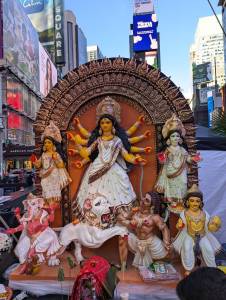
Durga Pujo. All one had to do was walk out on the road and have the multitudinous complexity of the city impinge upon one’s senses to feel Indian. One didn’t have to go to the temple or be religious to celebrate Durga Pujo. One could walk out into the city and see the city clad in lights and sounds and mouth watering smells of the roadside foodstalls.
The snarling crowds, the multistoried buildings, the traffic jams, the bookfairs, the demonstrations, the street plays, the road brawls, the strikes, the flooded roads in the monsoons and the confusion and excitement during elections were all India. Being part of the smells and the sounds and the sights was being Indian. Getting away from the lights and the sounds to escape the Pujo crowds and the cordoned off roads and the festival traffic jams to the seaside or the mountains was being Indian. Being intellectually elitist about getting too excited at festivals and being snooty was also Indian. Being religious and helping cut fruits and preparing the wicks for the diyas during the Pujo was also being Indian. Being an atheist and never waking up on time for “Anjali” in the morning but rushing to see a local famous singer to inaugurate a Pujo Pandal was being Indian. Criticizing the loss of faith and the degeneration of “culture” was Indian as was the exuberance at a local improvement of the roads or lamenting the breakdown of the education system in the state was Indian. The complexity of one cousin having an arranged marriage while another friend having a live-in relationship, one friend’s parents opposing an inter-caste marriage while another friend’s parents advertising “caste no bar” to look for a groom was all Indian.
Radicals and conformists, feminists and misogynists, believers and atheists were all everyday Indians. The city was full of them and one was full of the city.

Several years later in a small university town in Florida, I am still Indian. But I no longer need to get the oil, the masalas or the sunlight soap from home. The Indian store in my small university town has grown. A new one has opened up.
Now, when I go to India, I bring other small bits and and pieces of India with me. I bring hand-embroidered wall hangings and handbags with stitched inlays of small pieces of glass as gifts. I have learnt to buy packets of dry panipuris from the store and make the sweet and tikha chutney myself during Indian get-togethers. I know how to buy the puffed rice from Publix and mix it with the hot mixes from the Indian store and make jhalmuri which, I have to admit, turns out quite a good mix. It makes me understand, as a simple metaphor, certain lingos I am bombarded with daily –“a good mix of East and West”. I think I know now what it means.
I am still not very religious but have learnt to respect the solemnity of the Durga Puja Anjali’s that expatriate Indians take so seriously. It takes place on a weekend at the temple of some other god because Durga doesn’t have a temple by herself here. Being cavalier about the Puja any more would somehow feel like being un-Indian. So I am more serious now about getting up in the morning and taking a shower before leaving for the nearby big city to attend the Pujo.
I attend Asian-American group talks at the university. Occasionally I meet the American or the generous Indian involved in trying to help with some project in India. I remember that yes, we are a poor nation. I take part in debates on whether being in India or outside India is important for helping India. Often I meet the visionary Indian with the foresight to see India making its place on the world map through the technology revolution. I meet the mystic American at the Hare Krishna gatherings. I see blogs on the net by rebellious Indian-American kids who have been told that to have arranged marriage is Indian, to fall in love is western. This is the land of freedom and that is the land of tradition. I know what they mean too.

I am staring at a freshman reader for an English composition class in front of me. It has various impressive readings on writing across cultures. On the cover are several pictures from all over the world one beside the other– one of them a close up of a North Indian bride in her finery. Inside, amongst several essays, is a fictional autobiographical extract of a woman. The part selected is a scene when the groom and his family have come to see the girl for an arranged marriage.
I think of other short stories I have read. Always the docile bride, always the system, the tradition.
And then another picture rises in my mind. The huge steps in my college building in Calcutta in my undergraduate days and a demonstration. A huge number of girls protesting against the forcible removal of stray dogs from the college campus (who would be taken and killed perhaps by the municipality).
Did all those girls have arranged marriages eventually the way the girl does in the textbook? I don’t know– I have lost track of so many. I think of stories of my friend’s aunt, a young undergrad in the 1970’s, a thinker and a political activist in Calcutta. I think of my domestic help at home now, who, after a surgery at age nine could never have kids. She has married her boyfriend and has adopted a kid with the full support of her mom-in-law. I see the child coming to my house every afternoon while his mother works, catching up on his history lesson on the Stone Age.
I think of a myriad people sipping chai from their bhars (earthen pots), women with heavy baskets on their heads walking to the vegetable markets in the mornings who financially support their families, my neighbour’s upper-caste Hindu peon falling in love and defying his parents and marrying a Christian girl who was born out of wedlock. I think of the sensation in the city when we had our first woman bus conductor. I think of the increasing widowed or divorced middle class women who are falling in love and remarrying in India. I think of students sitting in the canteen discussing films and politics and pop culture in college canteens (cafeterias).
I think of the culture and tradition of love that is Indian. I think of the millions of people falling in love in India. Are they dating? Is the hip crowd “going around” or “going out” or “seeing someone”– is it just a different set of words? Even in traditional contexts, are there stolen glances, a rush to go to the balcony at the sound of a familiar deep voice, a beating of the heart at a stolen phone call, a sudden embarrassed smile and a rush of giggles from the younger siblings…..Or is it just a bride on the cover of a textbook with a fixed ghoonghat (head-covering) and a fixed smile on her face, upholding the tradition and culture of India?

India.
A collage on the posters on the wall. Pop up ads on the internet. A one hour documentary on Red Light areas of Bombay and Calcutta in Frontline. Starving children in need of adoption. An earthquake. A Diwali show. A Garba. Art films. Bollywood. Curry and Biryani. Earnestness and sincerity and enthusiasm and charity for the have-nots. Outsourcing. South Asian conferences and “postcolonial” theory. Unconsciously staring at a black-haired black-eyed stranger on the street for a second too long, perhaps in the hope of recognizing her. Rushing to meet someone who has just come back from India.
Nostalgia and passion for thousands of years old traditions. Nalanda and Ajanta and Ellora. Attending classical Eastern music concerts. A quickening of the heart at discovering a “made in India” label at the mall. Aishwarya appearing for a cosmetics ad on TV. Repeated explanations of weddings and rituals and languages–friendly answers to friendly questions in the bus perhaps. Do you speak Hindi? What are your weddings like? Do you know Gandhi? Tagore? Yoga? Are you aware that you are part of a 6000 year old civilization starting Indus Valley and Rig Vedas? Can you make rasgullas? Have you seen Jaisalmer or Konarak or at least the Taj Mahal?
Were you more Indian in India? Are you Indian? Are you becoming more Indian?
—————————————————————————————————————————–
I wrote this in December 2005. Since then, a lot has changed. Most importantly, because of the ubiquitousness of social media and the direct flights from New York (where I am now) to various places in India, the other part of the world does not seem so far away any more. But memories remain. My eldest Mashi (aunt) just passed away. Many of the brands mentioned here and the microwave oven have become very common back home. The pressure cooker, apparently, is now looked upon with suspicion in the US. This piece seems dated to me already.
©bottledworder, 2013. http://bottledworder.com
Share to show you care but with attribution only for non-commercial purposes. No derivative works.










 bottledworder
Leave a reply to kavishasaga Cancel reply